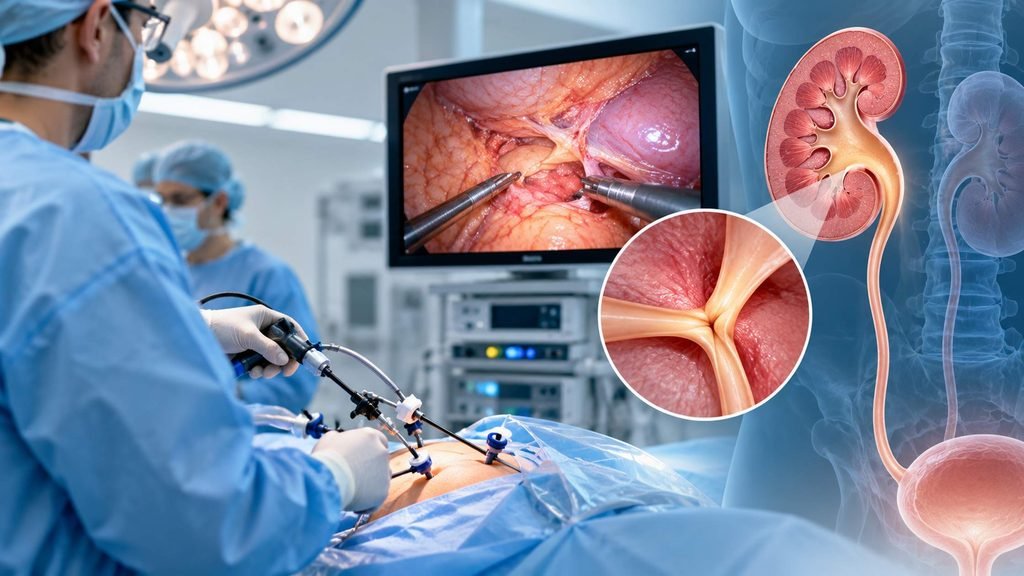
Ureteropelvic junction obstruction, also known as UPJ obstruction happens when urine is blocked from flowing from the kidney into the ureter. This blockage can be there from birth. Can appear later because of scarring, stones, earlier surgery, inflammation. When the blockage is serious urine builds up inside the kidney. This can cause swelling of the kidney, pain, infection, stones and damage, to kidney function.
At the Institute of Urology we look at patients who might have UPJ obstruction to decide whether to watch them or to do surgery. For patients who’re good candidates, Laparoscopic Pyeloplasty in Jaipur gives a Key hole surgery that aims to correct the obstruction and keep the kidney healthy.
What Is Laparoscopic Pyeloplasty?
Laparoscopic pyeloplasty is a type of surgery that fixes problems in the system. It is done through holes in the belly. The part of the ureter that’s too narrow is taken out. Then the healthy part of the ureter is joined back to the kidney. A small tube called a stent might be placed to help the area heal and to make sure urine flows properly.
Compared to surgeries that require bigger cuts laparoscopic surgery usually means tiny holes. It also means less pain after the operation. People often leave the hospital faster. Feel better quicker. The results are also better, in terms of how the body heals. The treatment chosen depends on the shape of the system how well the kidney is working the symptoms a person has and their general health.
When Is Surgery Usually Needed?
Not every UPJ obstruction requires immediate surgery. Patients without significant obstruction or kidney deterioration may be monitored with imaging and kidney function tests. Pyeloplasty may be recommended when obstruction causes important problems.
Common indications include:
- Persistent or recurring flank pain.
- Repeated urinary tract infections associated with poor drainage.
- Progressive hydronephrosis on ultrasound or CT.
- Reduced function of the affected kidney on a renal scan.
- Kidney stones caused by urinary stagnation.
- Worsening obstruction during follow-up.
- Significant nausea, vomiting, or discomfort.
- Anatomical blockage unlikely to resolve without reconstruction.
How Is UPJ Obstruction Diagnosed?
Diagnosis usually starts with a history, an examination and imaging. Ultrasound can spot hydronephrosis. CT urography can show the kidney, the ureter, stones and the surrounding structures. A nuclear renal scan can check drainage. Measure how much each kidney contributes to total kidney function. Blood tests and urine tests can evaluate kidney function and detect infection. Your urologist looks at all these findings together of depending on just one test.
Benefits of Laparoscopic Pyeloplasty
For appropriately selected patients, laparoscopic pyeloplasty can relieve obstruction and help protect the kidney.
Potential benefits include:
- Improved urine drainage.
- Relief from obstruction-related flank pain.
- Reduced risk of repeated infections.
- Smaller incisions than open pyeloplasty.
- Faster return to routine activities.
- Preservation of functioning kidney tissue.
Recovery After the Procedure
Recovery is different for each person. Depends on age overall health and what the surgeon finds during the operation. Most patients are told to walk after surgery and to follow the rules, about drinking water taking medicines taking care of the wound and what activities are allowed. A short tube might stay in place while the area that was fixed heals. Then it is taken out later as the surgeon decides.
Checking back with imaging is important because the progress is seen through how the person feels any fluid that comes out and how well the kidneys are working.
Why Choose Institute of Urology?
The Institute of Urology offers evaluation and treatment for problems in the tract including UPJ obstruction. People who are thinking about Laparoscopic Pyeloplasty in Jaipur can get a checkup based on their symptoms, imaging tests, kidney function and what kind of surgery is needed. The aim is to provide the treatment that focuses on keeping the kidney healthy doing a safe repair and making sure there is proper follow-up.
Expert Care at the Institute of Urology, Jaipur
Managing UPJ obstruction requires accurate diagnosis, assessment of kidney drainage and function, and careful selection of the most suitable treatment approach. In patients experiencing persistent flank pain, recurrent urinary infections, progressive hydronephrosis, impaired kidney function, or significant urinary obstruction, surgical treatment such as Laparoscopic Pyeloplasty In Jaipur may be recommended to restore normal urine flow from the kidney to the ureter.
At the Institute of Urology, Jaipur, patients have access to advanced diagnostic facilities, modern laparoscopic technology, and minimally invasive treatment options for UPJ obstruction and other complex urinary conditions. The treatment plan is determined after evaluating the severity of obstruction, kidney function, symptoms, imaging findings, presence of infection, and the patient’s overall health.
Under the expert guidance of Dr. M. Roychowdhury and Dr. Rajan Bansal, patients with routine as well as complex urological conditions receive personalised treatment plans based on their individual clinical requirements.
The institute provides comprehensive UPJ obstruction care under one roof, including specialist consultation, ultrasound and advanced imaging evaluation, renal function assessment, minimally invasive surgery, postoperative monitoring, stent management, and follow-up care. This integrated approach helps maintain continuity throughout diagnosis, treatment, recovery, and long-term kidney monitoring.
Patients looking for Laparoscopic Pyeloplasty In Jaipur can consult the specialists at the Institute of Urology to understand whether observation, further diagnostic evaluation, laparoscopic pyeloplasty, or another appropriate treatment option may be suitable for their condition.
Frequently Asked Questions
- Is every UPJ obstruction treated with surgery?
No. Mild or stable obstruction may be monitored. Surgery is considered when symptoms, poor drainage, infections, stones, or declining kidney function become concerning.
- Is laparoscopic pyeloplasty major surgery?
It is major reconstructive surgery under anesthesia, but it uses small keyhole incisions rather than a large open incision.
- Can UPJ obstruction damage the kidney?
Yes. Persistent severe obstruction can impair kidney function if not appropriately evaluated and treated.
- How long does recovery take?
Recovery differs, although many people resume routine activities within several weeks after minimally invasive treatment.
- Will I need a stent?
A temporary ureteric stent is commonly used to support drainage while the repair heals.
- Can UPJ obstruction return after surgery?
Recurrence is possible, although pyeloplasty generally has strong long-term outcomes. Follow-up remains important.
- Can adults develop UPJ obstruction?
Yes. Adults may develop obstruction after stones, surgery, inflammation, scarring, or anatomical changes.
- Which tests confirm UPJ obstruction?
Ultrasound, CT imaging, blood and urine tests, and a nuclear renal scan may be used.
Conclusion
UPJ obstruction needs treatment that depends on how severe it’s what symptoms appear how well drainage works and kidney health. If surgery is needed Laparoscopic Pyeloplasty In Jaipur can give a minimally invasive option, for patients who qualify.